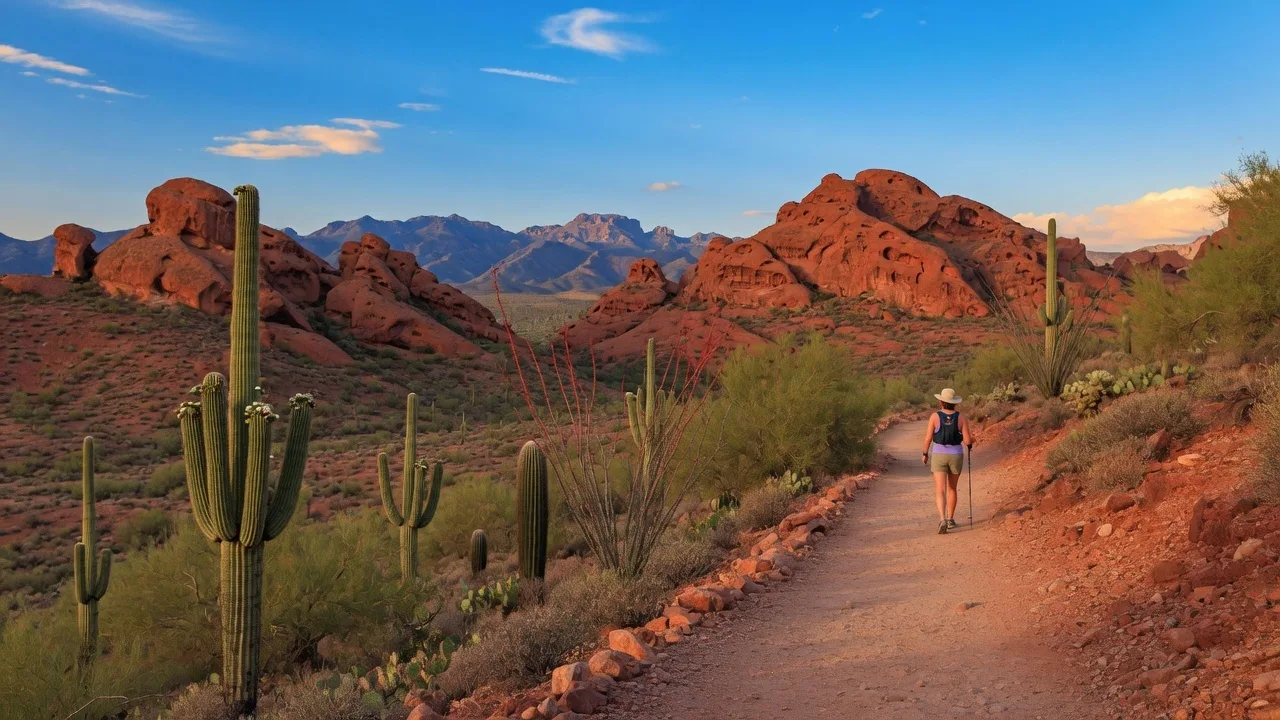
There are beautiful places in Arizona.
And then there is Sedona.
The first time you see those towering red rock formations rising above the landscape, it's easy to understand why people return again and again.
Sedona has a way of making you slow down.
You might arrive expecting a weekend of hiking and sightseeing.
Instead, you find yourself stopping along the road just to admire the mountains.
You take longer than expected at a viewpoint.
You sit outside for dinner.
You watch the light change across the rocks.
And eventually, you realize that Sedona isn't simply a destination.
It's an experience.
One of the best ways to experience it is on foot.
Sedona and the surrounding Verde Valley offer hundreds of miles of trails, with options ranging from relatively easy walks to challenging climbs.
But with so many choices, deciding where to start can be difficult.
Should you climb Cathedral Rock?
Walk beneath Bell Rock?
Search for the natural arch at Devil's Bridge?
Explore Boynton Canyon?
Or find a quieter trail away from the most popular spots?
I've put together this guide to help.
Hi, I'm Denise Hurd, a Realtor with RE/MAX Premier and more than 30+ years of Arizona real estate experience. As an AI Certified Agent, I spend a lot of time helping people understand not only Arizona real estate, but also the lifestyle that makes different communities special.
And Sedona is one of the best examples.
If you want to understand just how much outdoor recreation Arizona offers, my Expert Guide to Arizona Hiking is a great place to start.
But for now, let's head north and explore Sedona's red rocks.
Why Sedona Is One of Arizona's Best Hiking Destinations
Sedona's appeal comes down to one thing:
Variety.
You don't have to be an experienced mountain climber to enjoy Sedona.
There are relatively easy trails with spectacular scenery.
There are moderate hikes that reward you with incredible viewpoints.
And there are challenging routes for experienced hikers who want to work for the view.
The landscape changes constantly.
One trail may take you beneath enormous sandstone formations.
Another may lead you through a shaded canyon.
Another may climb onto a mesa with sweeping views across the Verde Valley.
And some trails combine natural scenery with the unique character that has made Sedona famous around the world.
Visit Sedona specifically recommends choosing trails based on your fitness level, interests, and seasonal conditions—and that's advice worth following.
The goal isn't to hike the hardest trail.
The goal is to find the trail you'll actually enjoy.
10 Best Sedona Hiking Trails for Stunning Views
1. Cathedral Rock Trail
If you've seen photographs of Sedona, there's a good chance you've seen Cathedral Rock.
This iconic formation is one of the most recognizable sights in Arizona.
And the hike gives you an opportunity to experience it from a much more personal perspective.
The trail is relatively short compared with many longer Sedona hikes, but don't let the mileage fool you.
The climb becomes steep and involves sections where you'll need to carefully navigate the red rock.
The reward?
Huge views.
From higher points along the route, you can look across Sedona's dramatic landscape and see why this area attracts hikers, photographers, and outdoor enthusiasts from around the world.
Cathedral Rock is best suited for hikers who are comfortable with elevation changes and some scrambling.
If you're looking for a leisurely walk, choose another trail.
If you're looking for a short hike with a serious visual payoff, Cathedral Rock deserves a spot near the top of your list.
2. Devil's Bridge Trail
Want to stand on one of Sedona's most famous natural formations?
Put Devil's Bridge on your list.
The trail leads to a massive sandstone arch that has become one of the area's most photographed hiking destinations.
The experience is about more than reaching the arch.
Along the way, you'll see the red rock landscape unfold around you.
And when you finally reach the bridge, the view is impressive from almost every direction.
Visit Sedona's current hiking materials identify Devil's Bridge as a moderate hike with a spectacular payoff at the natural sandstone arch.
One thing to remember:
Popular trails can get busy.
If you're hoping for a quieter experience, an early start can make a significant difference.
And don't rush the final viewpoint just because you've reached the destination.
Take a moment.
Look around.
That's the part you'll remember.
3. Bell Rock Pathway
Not every great Sedona hike needs to be difficult.
Bell Rock Pathway is an excellent example.
The trail provides views of the enormous Bell Rock formation and surrounding red rock landscape without requiring a strenuous climb.
It's particularly appealing for visitors who want:
- Beautiful scenery
- A more manageable trail
- Photography opportunities
- A family-friendly outing
- A chance to experience Sedona without committing to a major hike
Visit Sedona describes Bell Rock Pathway as a mostly flat option with excellent views of the iconic formation.
This is also a great reminder that you don't have to conquer a mountain to experience Sedona.
Sometimes the best hike is the one that lets you slow down and appreciate the scenery.
4. Boynton Canyon Trail
If you're looking for a longer trail with a completely different atmosphere, consider Boynton Canyon.
The trail takes you through a beautiful canyon environment surrounded by Sedona's characteristic red rock formations.
As you move deeper into the canyon, the scenery changes.
The towering walls create a sense of scale that photographs don't fully capture.
Boynton Canyon is also frequently mentioned among Sedona's popular hiking destinations, making it a good choice for visitors who want a longer experience rather than a quick viewpoint hike.
The important thing is to give yourself enough time.
Don't squeeze a longer trail into an already packed day.
Bring water.
Wear appropriate shoes.
And leave enough room to enjoy the landscape rather than watching the clock.
5. Doe Mountain Trail
If your priority is big views for relatively little hiking distance, Doe Mountain deserves your attention.
The trail climbs onto a mesa, and once you're up there, the reward is a broad perspective across the surrounding landscape.
Visit Sedona highlights Doe Mountain for its switchbacks and expansive views of formations and mountains throughout the area.
This is one of those hikes where the destination feels dramatically different from the trailhead.
At ground level, you see individual formations.
From the top, you start to understand how everything fits together.
You can see the surrounding mountains and red rock formations stretching across the horizon.
And that's one of my favorite things about hiking in Arizona.
The higher you go, the more the landscape tells its story.
Before You Choose Your Trail
Here's something I want every Sedona visitor to remember:
Don't choose a trail solely because it looks good on Instagram.
A photograph doesn't tell you:
- How steep the trail is
- How hot it may feel
- How much scrambling is involved
- Whether you're comfortable with exposure
- How crowded the trailhead may be
- How long the hike will actually take
Sedona's official tourism guidance recommends considering fitness level, seasonal conditions, sun position, and preparation before choosing a hike.
That matters because Arizona's outdoor conditions can change quickly.
The Southwest sun can be intense, and Visit Sedona advises hikers to prepare for changing weather, including heat, cold, wind, and sudden storms.
The Best Time to Start Your Sedona Hike
For many popular trails, early morning is your friend.
Starting early can help you avoid some of the day's heat and may make parking easier at popular trailheads.
It also gives you something special:
Morning light on the red rocks.
The colors can change dramatically as the sun moves across the landscape.
And if you're visiting during a warmer part of the year, an early start is even more important.
Don't wait until the middle of the afternoon simply because that's when your vacation schedule says it's time to hike.
In Arizona, sometimes the best hiking decision is simply:
Get up earlier.
What to Bring on a Sedona Hike
You don't need to overpack.
But you should be prepared.
Bring:
- Plenty of water
- Sun protection
- Comfortable hiking shoes
- A hat
- Sunglasses
- Snacks
- A small backpack
- A fully charged phone
- Navigation information
- Layers appropriate for the season
And remember:
Leave no trace.
Visit Sedona specifically recommends staying on designated trails, packing out trash, respecting wildlife, and leaving natural objects where you find them.
The red rocks belong to everyone.
Let's keep them beautiful for the people who come after us.
Sedona Is More Than a Hiking Destination
Here's something I think is easy to overlook.
People often think of Sedona as a hiking destination.
But the hiking is only one part of the experience.
There's also:
- Art
- Restaurants
- Wellness
- Scenic drives
- Local businesses
- Galleries
- Cultural experiences
- Historic sites
- Outdoor recreation
That's one reason Sedona can appeal to such a wide range of people.
You can spend the morning hiking and the afternoon exploring local galleries.
You can watch the sunset from a scenic viewpoint and enjoy dinner afterward.
You can make your trip as adventurous or as relaxed as you want.
And if you're interested in discovering the broader cultural side of Arizona, take a look at my guide to Arizona's best cultural experiences.
Arizona's personality extends far beyond its landscapes.
Why Sedona Can Change How You See Arizona
I've noticed something interesting over the years.
People who haven't spent much time in Arizona often have a very narrow picture of the state.
They imagine desert.
Heat.
Cacti.
Maybe Phoenix.
Then they visit Sedona.
Suddenly they're looking at red rock cliffs, forests, canyons, mountains, and completely different weather.
They realize Arizona isn't one landscape.
It's many.
That's one reason I encourage people considering relocation to explore the state before deciding where they want to live.
My guide Moving to Arizona? 15 Important Things to Know Before You Relocate explores this diversity in more detail.
Because the Arizona you imagine from another state may be very different from the Arizona you experience in person.
Sedona Can Also Be Part of a Larger Arizona Adventure
If you're planning a longer trip, don't stop with Sedona.
You can connect the area with other Northern Arizona destinations.
Depending on your schedule, consider exploring:
- Flagstaff
- Oak Creek Canyon
- Williams
- The Grand Canyon
- Historic Route 66 communities
If you're already planning a Grand Canyon trip, my Ultimate Grand Canyon National Park Itinerary: What to See in 2 Days can help you build the next part of your adventure.
And if you're interested in exploring the historic communities along Northern Arizona's Route 66 corridor, my Route 66 Centennial guide offers another perspective on the region.
The beauty of Arizona is that one trip can easily become several.
A Local Perspective on Sedona
After more than 30+ years in Arizona real estate, I've learned that lifestyle often becomes the reason people fall in love with Arizona.
It isn't always the house.
Sometimes it's the mountains.
Sometimes it's the restaurants.
Sometimes it's golf.
Sometimes it's hiking.
Sometimes it's simply being able to wake up on a Saturday morning and decide to explore somewhere beautiful.
That's why I believe travel and real estate are more connected than people realize.
When you understand how you want to spend your free time, you start understanding what kind of community you want to live in.
And that can make a huge difference when you're eventually choosing a home.
Sedona may not be where every buyer wants to live.
But it can help you discover what you want your Arizona lifestyle to feel like.
6. Soldier Pass Trail
If you want a trail that feels like you're discovering several Sedona landmarks in one hike, Soldier Pass Trail is a fantastic choice.
The trail takes you through a landscape filled with some of Sedona's most recognizable natural features.
Along the way, hikers can encounter:
- Devil's Kitchen
- Seven Sacred Pools
- Red rock formations
- Desert vegetation
- Dramatic canyon scenery
The Seven Sacred Pools are particularly beautiful when water is present, creating a striking contrast against the surrounding red rock.
But there's an important detail to understand before you go.
Soldier Pass is popular.
Parking and trail access can become challenging during busy periods, so planning ahead is important.
An early start can make the experience considerably more enjoyable.
And as with any Sedona trail, don't assume that a short distance automatically means an easy hike.
Take your time.
Enjoy the scenery.
And remember that the destination isn't the only attraction.
7. West Fork Trail
If you're looking for something completely different from Sedona's exposed red rock formations, head toward West Fork Trail.
This trail follows Oak Creek through a canyon surrounded by towering walls and trees.
It's a beautiful contrast to the open desert landscapes you'll see on many other Sedona hikes.
Depending on the season, you may encounter:
- Creek crossings
- Forest
- Canyon walls
- Changing foliage
- Cooler temperatures
- Peaceful water sounds
Fall can be especially beautiful here when the foliage changes color.
That makes West Fork a great reminder that Arizona isn't simply a desert state.
If you only know Phoenix or the lower desert, Northern Arizona can feel like another world.
Pine forests.
Cooler temperatures.
Streams.
Snow in higher elevations.
Red rocks.
All within the same state.
That's one of the reasons I always encourage people considering Arizona to explore beyond the areas they're initially familiar with.
8. Airport Loop Trail
Want panoramic views without committing to one of Sedona's more technical climbs?
Consider the Airport Loop Trail.
The trail provides sweeping views of Sedona's surrounding red rock landscape, making it particularly attractive for photographers and visitors who want a broader perspective.
One of the advantages of this area is that you can experience Sedona's landscape without necessarily spending your entire day on a strenuous hike.
And the views can be especially beautiful around sunrise or sunset.
The changing light brings out different shades in the red rock.
That's one of the things that makes Sedona so fascinating.
The landscape doesn't stay the same.
You can visit the same location twice and feel like you're looking at something completely different.
9. Fay Canyon Trail
For visitors who want a more relaxed canyon experience, Fay Canyon Trail is worth considering.
The trail takes you into a scenic canyon surrounded by Sedona's characteristic red rock formations.
Compared with some of the more famous climbs, Fay Canyon can feel more peaceful and immersive.
You're not constantly climbing toward a dramatic overlook.
Instead, the canyon itself becomes the experience.
That makes it an appealing choice for hikers who enjoy:
- Natural scenery
- Canyon walls
- Shade
- A slower pace
- Photography
- Exploring without a major summit climb
If you're traveling with people who have different hiking abilities, this type of trail can be a good option.
Not everyone needs to conquer a difficult trail for everyone to have a great day outdoors.
10. Bear Mountain Trail
Now let's talk about the opposite end of the spectrum.
Bear Mountain Trail is not a casual stroll.
It's one of the more demanding hikes on this list and is best suited to experienced hikers who are properly prepared.
But if you're looking for an adventure that rewards effort with expansive views, Bear Mountain can be an unforgettable experience.
The trail climbs significantly and requires good physical conditioning, appropriate footwear, plenty of water, and careful attention to weather conditions.
The reward is a dramatic perspective over Sedona and the surrounding landscape.
You don't simply see one red rock formation.
You begin to see the entire landscape working together.
And that's the payoff of challenging hikes.
Perspective.
You work for the view, and the view changes the way you understand the place.
The 10 Sedona Trails at a Glance
Here's a quick way to compare the trails.
Trail | Best For | General Experience |
|---|---|---|
Cathedral Rock | Experienced hikers & iconic views | Steep, dramatic climb |
Devil's Bridge | Iconic photography | Moderate, famous arch |
Bell Rock Pathway | Beginners & families | Easier, scenic |
Boynton Canyon | Canyon scenery | Longer, immersive |
Doe Mountain | Panoramic views | Shorter, steep climb |
Soldier Pass | Landmarks & variety | Popular, varied scenery |
West Fork | Forest & creek scenery | Relaxed, scenic |
Airport Loop | Panoramic views & photography | Moderate |
Fay Canyon | Relaxed canyon hiking | Easier, peaceful |
Bear Mountain | Experienced hikers | Challenging, expansive views |
The important thing is that there's no single "best" trail.
The best trail is the one that matches your ability, interests, schedule, and comfort level.
Which Sedona Trail Is Best for Beginners?
If you're relatively new to hiking, don't feel pressured to tackle Cathedral Rock or Bear Mountain just because they're popular.
Consider starting with:
Bell Rock Pathway
A good option for enjoying Sedona's scenery without committing to a major climb.
Fay Canyon
A more relaxed canyon experience that lets you enjoy the landscape at a comfortable pace.
West Fork
A beautiful choice if you're interested in trees, water, and canyon scenery rather than climbing.
Start with something you know you'll enjoy.
You can always come back for the harder trails.
Which Sedona Trail Is Best for Experienced Hikers?
If you're looking for more of a challenge, consider:
- Bear Mountain
- Cathedral Rock
- Longer portions of Boynton Canyon
- More demanding routes around the area
But difficulty should never be the only factor.
Weather matters.
Trail conditions matter.
Your physical condition matters.
And the amount of daylight available matters.
A challenging hike in perfect conditions can be an incredible experience.
The same hike under poor conditions can become dangerous.
Know before you go.
Which Sedona Hike Is Best for Photography?
This is difficult to answer because almost every trail offers something worth photographing.
But if your goal is dramatic landscapes, consider:
Cathedral Rock
Iconic red rock formations.
Devil's Bridge
One of Sedona's most recognizable natural arches.
Doe Mountain
Broad panoramic views.
Airport Loop
Excellent opportunities to capture Sedona's surrounding landscape.
Bell Rock
An iconic formation that's recognizable even to people who've never visited Arizona.
And don't forget about timing.
Light matters as much as location.
Early morning and late afternoon can create beautiful shadows and bring out the textures in the rock.
What Makes Sedona's Red Rocks So Special?
The hiking trails are impressive.
But the geology is the real star.
Sedona's red sandstone formations were shaped over millions of years.
Wind, water, erosion, and geological processes gradually created the cliffs, mesas, arches, canyons, and formations we see today.
That means you're not simply walking through a pretty landscape.
You're walking through a geological story.
And once you understand that, the trails become even more interesting.
A cliff isn't just a cliff.
A canyon isn't just a canyon.
You're looking at layers of history.
That's one reason Sedona feels so different from many other Arizona destinations.
Respect Sedona's Trails
Sedona's popularity has created challenges for the environment and the surrounding communities.
More visitors mean more pressure on trails, parking areas, roads, wildlife habitats, and natural resources.
That's why responsible hiking matters.
When visiting:
- Stay on established trails.
- Pack out everything you bring in.
- Don't remove rocks or plants.
- Keep your distance from wildlife.
- Follow posted restrictions.
- Respect private property.
- Don't create unauthorized trails.
- Keep dogs leashed where required.
- Be considerate of other hikers.
A beautiful place stays beautiful only when visitors take care of it.
Don't Forget the Red Rock Pass
Before heading out, check whether the trail you're visiting requires a Red Rock Pass or other applicable recreation fee.
Requirements can vary by location, so don't assume that one pass or rule applies to every trail in the Sedona area.
It's also worth checking current parking, shuttle, and trail information before leaving your hotel.
Sedona's popular trails can become busy, especially during peak travel periods.
A little planning can save you a lot of frustration.
Turn Your Sedona Hiking Trip Into a Full Arizona Experience
Here's where I think Sedona becomes especially interesting for people who are considering Arizona as more than a vacation destination.
Don't spend the entire day hiking.
Build a lifestyle experience around it.
Start with an early morning trail.
Have breakfast afterward.
Explore Sedona's galleries.
Visit local shops.
Have lunch.
Take a scenic drive.
Watch the sunset.
Enjoy dinner outdoors.
Now you're experiencing more than a hiking destination.
You're experiencing what life in Northern Arizona can feel like.
And that can be valuable information if you're trying to decide what kind of Arizona lifestyle appeals to you.
Sedona vs. the Phoenix Desert
One of the biggest surprises for people visiting Arizona is how different Sedona feels from the Phoenix metropolitan area.
Phoenix and the East Valley offer:
- Warm desert living
- Major employment centers
- Shopping
- Dining
- Sports
- Suburban communities
- Luxury real estate
- Extensive urban amenities
Sedona offers:
- Red rock scenery
- Smaller-community atmosphere
- Outdoor recreation
- Galleries
- Wellness
- Scenic drives
- Cooler conditions
Neither is "better."
They're simply different.
And that's precisely why understanding your lifestyle is so important before choosing where to live.
My Expert Review of Arizona Neighborhoods: Which Community Fits Your Lifestyle? explores this idea in greater detail.
What Hiking Can Teach You About Where You Want to Live
This might sound strange coming from a Realtor, but I think your hobbies can tell you a lot about the type of home you should buy.
If you hike every weekend, proximity to trails matters.
If you love golf, that changes your neighborhood priorities.
If you enjoy restaurants and nightlife, walkability and entertainment may matter more.
If you prefer quiet mornings and large lots, you may want a different community.
If you love art and culture, you'll probably want easy access to galleries, museums, and events.
Your home should support your lifestyle.
Not the other way around.
That's why I encourage buyers to think about what they want their Saturdays to look like before they decide what their house should look like.
Real-Life Insight From Denise
After more than 30+ years in Arizona real estate, I've learned that some of the most important conversations with buyers don't actually begin with bedrooms and bathrooms.
They begin with questions like:
What do you like to do on weekends?
Do you want to be close to restaurants?
Do you enjoy hiking?
Do you want mountain views?
How important is privacy?
Do you want a community where you can walk to local businesses?
Those answers can completely change the neighborhoods we consider.
A home can have a beautiful kitchen and an incredible primary suite.
But if it's an hour from the lifestyle you enjoy, it may not be the right home for you.
That's why I believe real estate is ultimately about lifestyle matching.
Why Working With an Experienced Arizona Realtor Matters
Arizona offers an enormous range of lifestyles.
You can live in a major metropolitan area, a luxury resort community, a suburban neighborhood, a master-planned community, a mountain town, or a quieter rural setting.
And sometimes the hardest part isn't finding a house.
It's figuring out where you belong.
As an AI Certified Agent, I use modern technology to help clients research communities, compare properties, organize information, and make the home search more efficient.
But technology is only part of the process.
Local experience matters.
Knowing how communities differ matters.
Understanding the lifestyle behind the ZIP code matters.
And that's where more than 30+ years of Arizona real estate experience can make a difference.
Your Sedona Hiking Weekend
If I were planning a simple Sedona hiking weekend, I'd keep it flexible.
Day 1
Morning
Start early with Cathedral Rock or Bell Rock.
Midday
Have lunch and take a break.
Afternoon
Explore galleries, shops, or another scenic area.
Evening
Find a beautiful sunset viewpoint and enjoy dinner.
Day 2
Morning
Try Devil's Bridge, Soldier Pass, West Fork, or another trail that matches your ability.
Afternoon
Take a scenic drive or explore the surrounding area.
Evening
Enjoy one last Sedona sunset before heading home.
The key is not trying to do everything.
Leave room to enjoy the place.
The Bottom Line
Sedona's red rocks are spectacular from the road.
But you understand them differently when you're standing on a trail beneath them.
You notice the layers.
The colors.
The shadows.
The scale.
The silence.
The changing light.
And that's why hiking is one of the best ways to experience Sedona.
Whether you're looking for an easy scenic walk or a demanding climb, there's a trail that can help you see this part of Arizona from a completely different perspective.
And once you discover how much Arizona has to offer beyond the Phoenix desert, you may start asking a bigger question:
What would it be like to actually live here?
Ready to Make Your Next Move With Confidence?
Buying a home is more than finding the right property.
It's about finding the right community, lifestyle, and environment for the life you want to build.
If hiking, outdoor recreation, beautiful scenery, and an active lifestyle are important to you, those priorities should be part of your Arizona home search.
I'm Denise Hurd, an AI Certified Agent with RE/MAX Premier, with more than 30+ years of Arizona real estate experience.
Whether you're considering Scottsdale, Gilbert, Paradise Valley, or another Arizona community, I'd love to help you find a home that fits not only your budget, but the way you want to live.
Check the comment section for the link to my site and additional Arizona real estate resources.
Frequently Asked Questions
What are the best hiking trails in Sedona?
Some of the most popular options include Cathedral Rock, Devil's Bridge, Bell Rock Pathway, Boynton Canyon, Doe Mountain, Soldier Pass, West Fork, Airport Loop, Fay Canyon, and Bear Mountain.
What is the easiest Sedona hiking trail?
Bell Rock Pathway and portions of Fay Canyon are among the more approachable choices, although difficulty can vary depending on the specific route and conditions.
What is the hardest hike on this list?
Bear Mountain is one of the more demanding hikes listed here. Cathedral Rock also requires steep climbing and scrambling in sections.
What is the most scenic hike in Sedona?
There's no single answer. Cathedral Rock, Devil's Bridge, Doe Mountain, and Airport Loop are all excellent choices for dramatic scenery and panoramic views.
What should I bring hiking in Sedona?
Bring plenty of water, sun protection, appropriate footwear, snacks, navigation tools, and layers suitable for the season. Always check current weather and trail conditions before starting.
Is Sedona good for beginner hikers?
Yes. Sedona has trails suitable for different ability levels. Beginners should choose routes that match their fitness and experience rather than selecting a trail based solely on popularity.
When is the best time to hike in Sedona?
Spring and fall are popular because temperatures are generally more comfortable, but every season offers a different experience. Summer hikers should take extra care with heat, while winter visitors should prepare for colder conditions and changing weather.