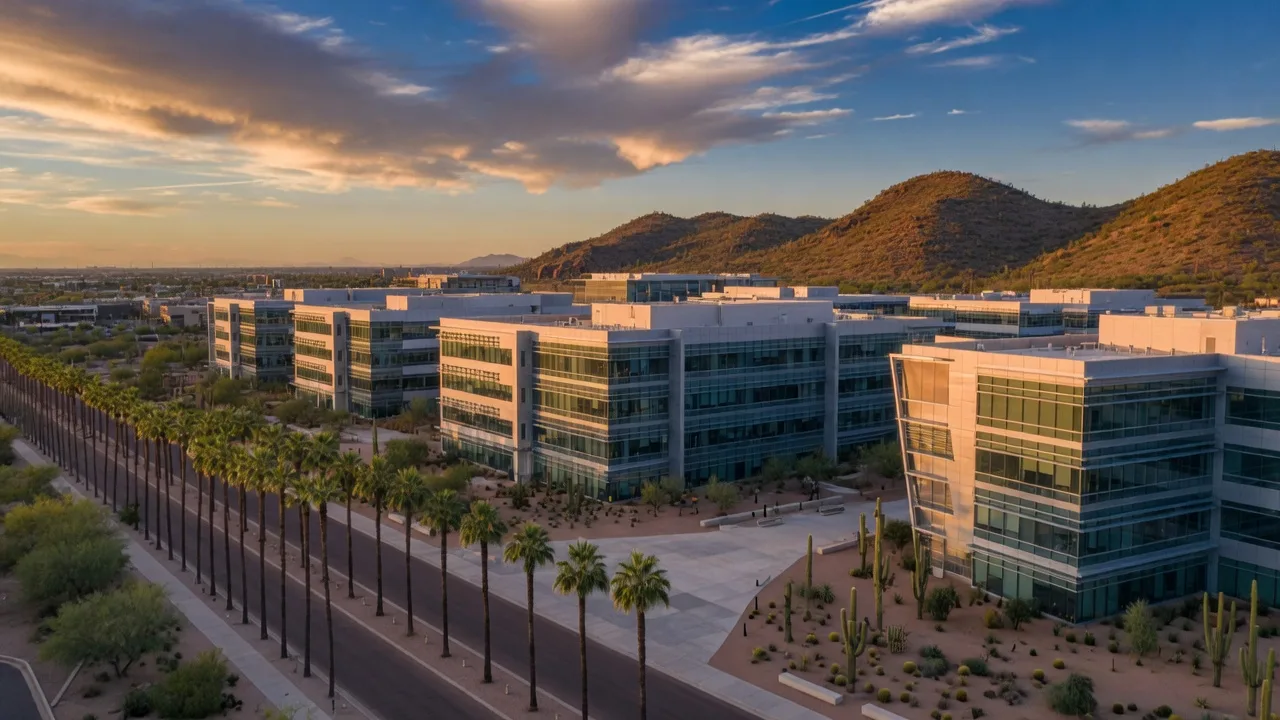
How Arizona's Tech Scene Is Exploding

How Arizona's Tech Scene Is Exploding

  • Denise Hurd
  • September 3, 2026

For years, Arizona was known for sunshine, golf, retirement communities, and desert living.

Today, there's another word increasingly associated with the state:

Technology.

Something much bigger is happening across Arizona.

Semiconductor manufacturing is expanding.

Artificial intelligence is creating demand for new infrastructure.

Advanced manufacturing is growing.

Aerospace and defense companies continue to invest.

Startups are raising capital.

And communities across the Phoenix metro are building the infrastructure and workforce needed to support it all.

The Arizona Technology Council's latest 2026 industry report highlights continued momentum in advanced manufacturing, aerospace and defense, semiconductors, artificial intelligence, cybersecurity, and applied research.

And this isn't just about technology companies.

It can affect jobs, housing, infrastructure, schools, restaurants, retail, and the communities people choose to call home.

After more than 30+ years in Arizona real estate, I've watched the Valley change in many ways.

What we're seeing now feels different.

Arizona isn't simply attracting people who want to escape cold weather.

It's increasingly attracting people who want to build careers here.


Arizona's Tech Boom Didn't Happen Overnight

One of the biggest misconceptions about Arizona's technology industry is that it suddenly appeared.

It didn't.

The foundation has been developing for years.

Companies invested in Arizona because of factors such as available land, infrastructure, business conditions, workforce development, universities, and the state's growing population.

Greater Phoenix has also developed a reputation as a major technology market.

From 2020 through 2024, startups in the Greater Phoenix area raised more than $6 billion in venture capital funding, according to the Arizona Center for Investigative Reporting.

That startup activity is only one part of the story.

The other part is much larger.

Manufacturing.


TSMC Is Changing the Arizona Technology Story

If there is one company that symbolizes Arizona's transformation into a technology manufacturing powerhouse, it's Taiwan Semiconductor Manufacturing Company, or TSMC.

And the scale of its Arizona investment is enormous.

In July 2026, TSMC announced another $100 billion investment in Arizona, bringing its planned total investment in the state to approximately $265 billion.

The expansion includes additional advanced semiconductor fabrication facilities, advanced packaging facilities, and a research and development center.

That's not simply a new factory.

It's an ecosystem.

Semiconductor manufacturing requires engineers, technicians, construction workers, suppliers, logistics companies, researchers, equipment manufacturers, and countless other supporting businesses.

That means the economic impact can extend far beyond the factory gates.

And it helps explain why the Phoenix area is becoming increasingly important to the national technology industry.


Chandler Is Becoming a Major Technology Center

If you're interested in Arizona's tech scene, don't overlook Chandler.

The city has spent years developing itself as a technology and innovation hub.

Chandler's technology economy includes:

  • Semiconductor manufacturing
  • Software development
  • Data centers
  • Network solutions
  • Advanced manufacturing
  • Automotive technology
  • Aerospace and aviation
  • Healthcare technology

The city describes itself as a "Community of Innovation," and its economic development strategy is built around industries that support a highly skilled workforce.

Its Price Corridor alone includes major employers such as Intel, Northrop Grumman, and Microchip Technology.

This is important for more than business owners.

Technology companies bring employees.

Employees need homes.

Families need schools.

People need restaurants, grocery stores, entertainment, healthcare, parks, and transportation.

Economic growth eventually becomes community growth.


Intel Has Helped Build Arizona's Semiconductor Identity

TSMC isn't operating in isolation.

Intel has also played a major role in Arizona's semiconductor industry.

The company's Chandler operations have become a significant part of the region's technology and manufacturing ecosystem.

According to Chandler's economic development data, Intel is one of the city's largest employers in the Price Corridor, with approximately 10,000 employees listed in the corridor's employer profile.

This creates another important advantage for Arizona:

an existing technology workforce.

The more companies that establish operations here, the easier it can become for other companies to find experienced workers, suppliers, contractors, and business partners.

That's how technology clusters grow.


It's Not Just About Semiconductors

When people hear "Arizona tech," they often think about chips.

But the technology ecosystem is much broader.

Arizona's current growth also includes:

Artificial Intelligence

AI is creating demand for computing infrastructure, specialized chips, data centers, software, and highly skilled workers.

Aerospace and Defense

Arizona has long had a strong aerospace and defense presence, and the technology surrounding those industries continues to evolve.

Cybersecurity

As businesses become more dependent on digital infrastructure, cybersecurity becomes increasingly important.

Advanced Manufacturing

Modern manufacturing is becoming increasingly automated and technology-driven.

Automotive Technology

Chandler identifies automotive technology as one of its emerging industries, including companies developing and testing new automotive technologies.

That's a much bigger technology story than simply saying:

"Arizona has startups."


AI Is Adding Another Layer to the Boom

Artificial intelligence is changing what companies need from their physical infrastructure.

AI requires enormous computing power.

That means demand for:

  • Semiconductors
  • Servers
  • Data centers
  • Cooling systems
  • Power infrastructure
  • Fiber networks
  • Specialized construction
  • Engineering talent

Arizona is positioning itself within several of those supply chains.

TSMC's expanding semiconductor operations are particularly relevant because advanced chips are central to the AI economy. TSMC itself has cited strong multi-year demand for AI chips as a reason for expanding its Arizona investment.

But there is an important reality here.

Technology growth isn't effortless.

Infrastructure has to keep up.

Power has to be available.

Water has to be managed responsibly.

Communities have to decide where large facilities belong.

And residents have to see enough benefit to support continued development.

The technology boom will create opportunities, but it will also require thoughtful planning.


Mesa Wants a Bigger Role in the Technology Economy

The tech story isn't limited to Chandler and North Phoenix.

Mesa is also positioning itself for future semiconductor investment.

In August 2026, Mesa's mayor traveled to Taiwan to strengthen relationships with Taiwanese businesses and government officials and explore future semiconductor opportunities. The trip coincided with SEMICON 2026 and reflects the city's efforts to attract additional technology investment.

That matters because economic development is increasingly happening across multiple Valley communities.

Phoenix may have TSMC's massive presence.

Chandler has a deep semiconductor and technology ecosystem.

Mesa wants to capture more of the next wave.

And Gilbert is building its own economic-development infrastructure.


Don't Forget Gilbert

Gilbert may not be the first community that comes to mind when someone says "Arizona tech."

But that's changing.

Gilbert's economic development organization identifies several employment corridors, including areas supporting science, technology, engineering, and mathematics occupations, as well as aerospace and aviation.

The community also has a relatively young workforce, with its economic development organization noting that about 30% of its population is between ages 25 and 44.

This is important from a real estate perspective.

A growing technology economy doesn't only create office buildings.

It creates demand for communities where highly skilled workers want to live.

And Gilbert has several characteristics that can make it attractive to that workforce.


What Does This Mean for Arizona Real Estate?

This is where the technology story becomes especially interesting to me as a Realtor.

When major employers move into a region, they don't simply occupy buildings.

They create housing demand.

A new technology worker may need a condo.

A relocating executive may want a luxury home.

A growing family may need a larger property.

A business owner may want to be close to an employment center.

And as communities grow, developers respond with new housing, restaurants, retail, schools, parks, and other amenities.

This doesn't mean every home near a technology project automatically becomes a great investment.

Real estate is much more complicated than that.

But employment growth is one of the factors I watch closely when evaluating the long-term story of a community.


Technology Could Change Where People Choose to Live

The old question was:

"Where is the office?"

The newer question is:

"How do I want to live while working in this industry?"

That's an important distinction.

Technology workers may prioritize:

  • Shorter commutes
  • New construction
  • High-quality schools
  • Restaurants and entertainment
  • Outdoor recreation
  • Luxury amenities
  • Larger homes
  • Access to airports
  • Strong community amenities

And Arizona offers a surprisingly wide range of options.

Someone working in the East Valley may have very different housing choices from someone working near North Phoenix.

That's why understanding where the jobs are growing can be just as useful as understanding where the homes are being built.


The Scottsdale Connection

Scottsdale isn't primarily known as a semiconductor manufacturing center.

And that's exactly why it's interesting.

The city's appeal is more lifestyle-driven.

Luxury housing.

Golf.

Restaurants.

Resorts.

Shopping.

Arts and culture.

Outdoor recreation.

For executives and highly compensated professionals working in Arizona's expanding technology economy, Scottsdale can offer something different from living directly beside an employment center.

It's one reason I continue to see Scottsdale as an important part of Arizona's broader luxury real estate story.

If you're interested in that market, my Scottsdale Luxury Guide is a useful next step.


What Arizona's Tech Boom Could Mean for the Future

We're still early in this story.

TSMC's expanded investment alone represents an enormous long-term commitment.

The Arizona Technology Council is also seeing continued growth across advanced manufacturing, semiconductors, AI, aerospace, cybersecurity, and applied research.

But I don't think the most interesting question is:

"Will Arizona become a tech state?"

I think that question has already been answered.

The more interesting question is:

"What kind of technology state will Arizona become?"

Will it primarily be a semiconductor manufacturing hub?

Will AI infrastructure become a larger part of the economy?

Will startups grow alongside major corporations?

Will universities produce the talent needed to support the industry?

Will housing and infrastructure keep pace?

Those questions will shape Arizona for decades.


Real-Life Insight From Denise

After 30+ years in Arizona real estate, I've learned that communities don't transform because of one company or one announcement.

They transform through momentum.

One major employer attracts another.

New workers create demand for housing.

Housing attracts restaurants and services.

Infrastructure improves.

Businesses follow the workforce.

And suddenly, a community that looked very different ten years ago has a completely different identity.

That's why I pay attention to economic development.

Real estate isn't just about what a neighborhood looks like today.

It's also about understanding what is happening around it.


Why Working With an Experienced Arizona Realtor Matters

For buyers relocating to Arizona, understanding the technology economy can be useful even if you don't work in technology.

Economic growth can influence where people move, where new development occurs, and which communities experience increasing demand.

As an AI Certified Agent with RE/MAX Premier, I combine modern technology with more than 30+ years of Arizona real estate experience to help clients look beyond the property itself.

If you're relocating to Arizona because of a new career opportunity, my Arizona Relocation Guide is a natural place to start.

And if you're ready to explore the actual home-buying process, my Arizona Home Buyer's Guide can walk you through the next steps.


The Bottom Line

Arizona's technology story is no longer just a prediction.

It's happening.

TSMC is investing billions.

Intel remains a major presence.

Chandler continues to attract advanced technology companies.

Mesa is actively pursuing additional semiconductor opportunities.

Gilbert is developing its technology and aerospace employment corridors.

AI is creating new demand for chips, data centers, infrastructure, and skilled workers.

And all of that is changing more than Arizona's economy.

It's changing Arizona's communities.

For me, that's the most interesting part.

Because when technology companies move in, people follow.

And when people follow, real estate follows them.

Arizona isn't simply becoming a place where technology companies do business.

It's becoming a place where technology professionals can build a life.


Ready to Make Your Next Move With Confidence?

Buying a home is more than finding the right property. It's about finding the right community and lifestyle for the life you want to build.

If you're moving to Arizona for a new career, expanding business, or simply looking for a state with a growing economy and lifestyle opportunities, I'd love to help you understand which communities make sense for you.

I'm Denise Hurd, an AI Certified Agent with RE/MAX Premier, with more than 30+ years of Arizona real estate experience.

Check the comment section for the link to my site and additional Arizona real estate resources.


Frequently Asked Questions

Is Arizona becoming a tech hub?

Yes. Arizona has developed significant technology clusters around semiconductors, advanced manufacturing, aerospace and defense, AI, cybersecurity, and software. Greater Phoenix has also seen substantial startup investment.

Why are technology companies moving to Arizona?

Factors include Arizona's workforce, infrastructure, available land, business environment, semiconductor ecosystem, research partnerships, and growing population. Different companies have different reasons for choosing the state.

Where is Arizona's tech industry concentrated?

Major activity is spread across the Phoenix metro, including North Phoenix, Chandler, Mesa, Gilbert, and other East Valley communities. Chandler has particularly strong semiconductor, software, advanced manufacturing, and technology employment clusters.

What does TSMC's Arizona investment mean?

TSMC's latest expansion brings its planned Arizona investment to approximately $265 billion and includes additional advanced semiconductor facilities, packaging facilities, and research and development infrastructure.

Will Arizona's tech growth affect housing?

It can. Major employment growth can create additional demand for housing, services, retail, and infrastructure. However, individual neighborhoods and property values respond to many factors, so technology investment should be viewed as one part of a larger real estate analysis.

Is Gilbert benefiting from Arizona's technology growth?

Gilbert is developing employment corridors that include STEM-related occupations and aerospace and aviation, while also maintaining a relatively young workforce and expanding development capacity.


Sources

  • Arizona Technology Council — 2026 Technology Industry Impact Report
  • City of Phoenix — TSMC's Additional $100 Billion Arizona Investment
  • Arizona Commerce Authority — TSMC Arizona Expansion
  • City of Chandler — Key Industries & Employers
  • City of Chandler — Price Corridor
  • Arizona Center for Investigative Reporting — Phoenix Technology Growth
  • Gilbert Office of Economic Development

Work With Us

Etiam non quam lacus suspendisse faucibus interdum. Orci ac auctor augue mauris augue neque. Bibendum at varius vel pharetra. Viverra orci sagittis eu volutpat. Platea dictumst vestibulum rhoncus est pellentesque elit ullamcorper.

Follow Us on Instagram